

July 2025’s savings round-up & news

The latest news to help you get the most from your savings account.

Here’s my monthly update sharing changes at leading UK savings accounts, as well as some of the articles you might have missed on the site.

Some articles on the site contain affiliate links, which provide a small commission to help fund our work. However, they won’t affect the price you pay or our editorial independence. Read more here.

July’s savings news

Premium Bond prize rate cut

Sorry to begin the round-up with some bad news, but it’s important for all you Premium Bond holders out there.

We had a spate of prize rate cuts since March last year, taking us from a high of 4.65% all the way down to 3.6%, which will apply as of the August draw.

The odds of winning will stay at 22,000 to 1, and the number of prizes available will actually increase by almost 37,000.

But it’s the total prize fund that’s decreasing, this time by a massive £19 million. In total, the prize fund will be worth around £396.7m, down from £411 million. This is as a result of the change in how many of each prize are now available.

In reality, what we are seeing is that the number of lower value prizes increase at the expense of cuts at other levels. So while your chances of winning a prize will stay the same, because the odds are staying the same, you’re more likely to win one of the lower value prizes.

It’s not great news for Premium Bond savers hopeful of winning the jackpot and there are plenty of savings accounts that beat the new 3.6% prize rate – and offer guaranteed interest.

But, if you are thinking of moving your money (see the pros and cons of Premium Bonds if you’re not sure), it’s best to wait after the August draw, just in case you win something for stashing your money in the bonds for July.

Halifax scraps savers prize draw

In other prize draw news, Halifax is getting rid of its Savers Prize Draw altogether. The draw has been running since 2011, and every month there are over a thousand cash prizes to be won. These include three prizes of £100,000, 100 prizes of £1,000 and 1,500 prizes of £100. Sometimes there was a ‘superdraw’ with higher-value prizes, including one of £500,000.

To be eligible for the prize draw, savers need to have a minimum of £5,000 in a qualifying account for a month (a Halifax and/or Bank of Scotland personal savings account), and be registered to take part. You’ll also need to be aged 18 or above and live in England, Wales or Scotland.

But you’ve not got long to win. Halifax has notified customers that the last prize draw will be in September, and qualifying customers will be entered into the remaining prize draws automatically.

If you are a qualifying Halifax customer, make sure your contact details are up to date. And if you’re looking to move your savings, do check out the top rates on our savings best buy tables.

Zopa launches new 7.1% regular saver

Zopa’s offering a new 7.1% regular saver that sits alongside its new Biscuit current account – which has been in beta testing for a while.

It’s a top rate paid on up to £300 a month (the only one that beats it is Principality’s six month regular saver which offers 7.5% although it’s only for six months) and is likely to be an attractive option for those who like to save small amounts each month.

You’ll need to open the Biscuit current account to get it – which isn’t unusual with regular savers. If you save the full amount each month, you could earn £137 in a year – as long as Zopa doesn’t reduce the rate, which it could well do.

An unusual feature of this regular saver is that you can actually make withdrawals and replace the money in the same month. Usually, you can’t take any money out with other providers, so this Zopa one is a bit more flexible.

However, it’s worth noting that you won’t be able to add more than £300 to the account each month – even if you make withdrawals. So if you take out say £600 from your balance one month, you’ll only be able to replace it with £300.

Chase offers 5% for new customers

If you’re looking for a new savings account, and you’ve never been a Chase customer before, you might want to check out its 5% boosted savings account. On top of its standard savings rate it includes a 2.25% fixed bonus for 12 months, so that won’t change.

However, the standard 2.75% rate is variable and linked to the Bank of England base rate. So if the base rate falls, Chase cuts its rate so it’s 1.5 percentage points below it.

You’ll need to open a Chase current account first and then open a a Chase saver with boosted rate within 31 days of becoming a new customer.

No bonus on Trading 212 ISA transfers

Trading 212 has been offering plenty of decent ISA rates recently, which usually include a fixed bonus.

For example, at the moment its easy access Cash ISA pays 4.92% including a bonus rate of 0.82%.

However, be warned the bonus doesn’t apply to ISA transfers – so if you move your ISA money from another provider to Trading 212 using the transfer process, you’ll only get the standard rate.

Bank of England base rate held at 4.25%

After two cuts this year, the Bank of England base rate was held at 4.25% at the latest meeting.

In short, it means no immediate reductions to savings or mortgage rates but financial markets are still expecting further cuts by the end of the year. However, the Bank of England has said any changes will be ‘gradual and careful’, so a lot less aggressive than previous predictions suggested.

It seems that at the moment economists are divided on what could happen next. There’s still a whole load of political and economic uncertainty around the world and escalations in the Middle East could add to that.

Some experts are predicting just the one cut by the end of the year, taking the base rate to 4%, while others say there will actually be two more taking interest rates to 3.75% by the end of the year. And there are some who are still sticking with three cuts, one in August, November and December, reducing the base rate to 3.5%.

So anything could happen!
July’s savings offers

We’ll share any other deals in our savings deals page if any more come along.

Top savings accounts for July 2025

Remember, these are the accounts at the top of the tables. We’ve more options in our best savings accounts page, which is updated every day by the team.

Current account linked saver picks as of 30/6/25

  • Santander Edge Saver (6% AER variable, includes 2% bonus for 12 months): max £4,000
  • Chase (5% AER variable, includes 2.25% bonus fixed for 12 months): max £3m
  • Nationwide (5% AER variable for 12 months): max £1,500

Easy access ISA picks as of 30/6/25

  • Trading 212 (4.92% AER variable, includes 0.82% bonus for a year)
  • Plum (4.92% AER variable, includes 1.63% bonus if account is kept for 12 months)
    • drops to 3.29% if balance falls below £100 or after your fourth withdrawal
  • Tembo Money (4.64% AER variable) – highest easy-access if ineligible for new customer bonuses elsewhere

Easy & limited access picks as of 30/6/25

  • Cahoot Rainy Day Saver (5% AER variable): max £3,000
  • Atom (4.75% AER variable)
    • drops to 2.5% in months you make a withdrawal
  • Snoop (4.6% AER variable)

Notice accounts picks as of 30/6/25

  • 3 months notice Oak North via Prosper (4.74% AER variable): 95-days notice

Fixed savings accounts picks as of 30/6/25

  • 6 months Oxbury Bank (4.48% AER fixed)
  • 12 months Cynergy Bank (4.55% AER fixed)
  • Marcus by Goldman Sachs (4.55% AER fixed)
  • 18 months Nationwide (5% AER fixed)
    • Must have been existing Nationwide member on 28 May 2025 to open
  • 18 months Oxbury Bank (4.45% AER fixed)
  • 2 year Cynergy Bank (4.45% AER fixed)
  • 3 year Cynergy Bank (4.45% AER fixed)
  • 4 year JN Bank (4.4% AER fixed)
  • 5 year Birmingham Bank (4.47% AER fixed)

Fixed ISA accounts picks as of 30/6/25

  • 12 months Cynergy Bank (4.35% AER fixed)
  • 2 years Marsden Building Society (4.3% AER fixed)
  • 3 years Cynergy Bank (4.25% AER fixed)
  • 4 years UBL (4% AER fixed)
  • 5 years Close Brothers (4.24% AER fixed)

Lifetime ISA pick as of 30/6/25

  • Moneybox Cash Lifetime ISA (4.76% AER variable)
    • includes 1.46% fixed bonus for 12 months

Regular Saver accounts picks as of 30/6/25

We’ve got a dedicated Regular Saver best buy article, so you can see further details and more rates there.

  • Principality Building Society 6-month regular saver (7.5% AER fixed): min £0 / max £200 a month
  • Zopa Regular Saver (7.1% AER variable): min £1 / max £300 a month
    • requires a Biscuit (by Zopa) current account
  • First Direct Regular Saver (7% AER fixed): min £25 / max £300 a month
    • requires a First Direct current account
  • Co-operative Bank Regular Saver (7% variable): min £1 / max £250 a month
    • Requires a Co-op Bank current account
  • Nationwide Flex Regular Saver (6.5% AER variable): min £1 / max £200 per month
    • max 3 withdrawals per year, after which your rate drops to 2.15%.
    • Requires Nationwide current account

Our deals of the week 27 June 2025

Our pick of the best offers and savings.

Every week we spend hours looking at discounts and deals to pick the good from the bad. We’ll only share ones which we think are worth considering – but remember you’re only saving money if you’re buying something you need and can afford.

Some articles on the site contain affiliate links, which provide a small commission to help fund our work. However, they won’t affect the price you pay or our editorial independence. Read more here.

This week’s deals

Cash ISAs: rates rising to 4.92%

Trading 212 and Plum have been fighting for the top spot, with both offering the highest ISA rates of 4.92%.

TSB switch offer: up to £190 + £30 + £120 hotel credit (ends Monday)

If you haven’t taken advantage of TSB’s latest bank switch offer, now’s your chance! Act fast, because it comes to an end on 30 June 2025.

School Uniforms: entire sets from £5

Aldi and Lidl are offering full sets of school uniform for kids aged between 4 – 12 for just £5, while Asda and Tesco are offering 25% off if you’re signed up to their loyalty schemes – but only until 29 June 2025.

Wine: 25% off 6 bottles

Buy six or more bottles of wine at Sainsbury’s or Tesco, and you’ll get 25% off the total!

Disney+: £1.99 per month for 4-month subscription (ends Monday)

Until 30 June 2025, new and returning Disney+ users can get a 4-month subscription for just £1.99 per month. That saves you a total of £12 when compared to the full price.

Asda: £6 in cashpot

Save £60 towards your Christmas shopping with an Asda Christmas Savings Card, and you’ll get an extra £6 added to your cashpot. You’ll have to hurry though as the deal ends on 29 June.

Amazon Prime: early Prime deals

Early deals for Prime Day are starting to roll in! So far they include a free 4-month trial of Amazon Music Unlimited, a 3-month trial of Audible, and up to 50% off movies and TV.

Argos: £5 off £40 spend

If you’re not currently receiving marketing emails from Argos, sign-up to receive a unique code that will get you £5 off when you spend £40.

Tesco: free items with online shop

Until 20 July 2025, you can get a free full-sized jar of Bonne Maman Crunchy Hazelnut Chocolate Spread with your Tesco online shop. There’s also a free Get More Vits drink available, and a trial sample of Comfort Scent Booster.

The cheapest ways to get Wimbledon 2025 tennis tickets

From the ballot to the queue, here’s how to get in at SW19

Wimbledon is one of the highlights of my summer, even though getting a ticket to see the tennis isn’t always cheap or easy – but you can do it on a budget.

Here are my top tips for getting a ticket.

Some articles on the site contain affiliate links, which provide a small commission to help fund our work. However, they won’t affect the price you pay or our editorial independence. Read more here.

Andy Webb at Wimbledon
Me having just got into the grounds in 2018.

1. Go in the first week

In terms of value for money, the best way in my experience is to go towards the end of the first week (which this year starts on Tuesday 30 June). 

At this point, the tournament will be in the second or third round where the players will be much more evenly matched. Round one games, especially with the top seeds, can often be a whitewash. 

If you want to experience Centre Court, the cheapest tickets are for the first couple of days.

2. Try to buy last-minute tickets

If you’re looking to guarantee a ticket before heading out, such as if you live a little further afield, then last minute ticket options might be an option.

Try your luck the day before

Some tickets are typically sold a day or two before, but there’s no details on the website about them just yet. You normally need to download the official Wimbledon app to get them, so it’s worth downloading and signing up to prep. 

American Express cardholder tickets

American Express cardholders might be able to grab themselves some last-minute tickets to Centre Court during the tournament. It’s not been confirmed for 2025 yet, but if it’s running again any sales will be revealed on Amex socials this year, so give them a follow.

Ballot tickets

You might still be able to get access to returned ballot tickets – these will be restricted to those who were unsuccessful in the ballot. Those who are eligible will get an email detailing how to access the resale. 

In previous years you needed to be quick. Several hundred tickets for Centre Court and Court 3 went on sale at 9am the day before. Returns for the same courts went on sale roughly 48 hours before the start of play, also via Ticketmaster. 

It’s a good idea to sign up for the Wimbledon newsletter to be the first to know of any extra ticket releases.

3. Join the queue

The queue is a great way to nab yourself some great tickets on the day. It’s an early start, especially if you live outside of London, but it’s quite an experience in itself – you even get a booklet on how to queue (how British!). 

It’s first-come, first… serve (sorry) so the earlier you join the queue the better. If you want a show court you’ll need to be there overnight. A limited number of tickets are available for Centre, No.1 and No.2 Courts. Only one ticket can be bought per person, so you need to be queuing together to get more than one.

For other tickets, well the earlier the better is still the case. Historically, we’ve arrived at around 7am, and didn’t get into the grounds until just gone 1pm! But for most of that time we were just sat in the sun in a field which was actually really nice – just bring a book! There are toilets, food outlets and water refill stations.

Gates open gradually from 9.45am and play normally starts on outer courts around 11am. There’s usually a comprehensive guide to the queue on the Wimbledon website which details how it’s handled.

This year you’ll need to download the Wimbledon app and sign into a MyWimbledon account so it’s worth doing this ahead of time.

People queuing for Wimbledon
The Wimbledon queue when we arrived just after 7am

4. Get a ground pass

The best way to save money on Wimbledon is to get a Grounds Pass – these let you watch some quality tennis on the outer courts for a fraction of the price. In week two you’ll have fewer singles to watch but don’t worry, there’ll be some great doubles action if you go on a Monday or Tuesday.

If you are early (and quick) there are also some unreserved seats and standing space on Court 3. A ground pass will cost you £30 during the first week, less from the second Tuesday onwards.

5. Get £10 returns

It used to be that extra tickets went on sale from a hut inside the grounds. These became available as people left for the day and donated their ticket to be resold, with profits going to charity. But it meant more queuing!

The good news is this changed recently, and you can now do it via the Wimbledon app. You’ll need to get your phone scanned at kiosks in the grounds or the queue by 2.30pm. Then as tickets become released between 3pm and 9pm, keep an eye out for a text message saying you’ve “won” a show court seat.

You’ve 10 minutes from the text to accept it, and another 20 minutes to pay for your ticket from the resale kiosk by Court 1.

Costs in 2025 were:

  • Centre Court: £15
  • No 1 Court: £10
  • No 2 Court: £10

6. Bring your own food

Once you’re in, it gets very expensive. Check the T&Cs on your ticket and on the Wimbledon website, but to avoid paying high prices for disappointing burgers, bring a picnic. The same is the case with drinks. You’re allowed to bring your own booze – though not spirits – and there are (fairly generous) limits per person. Remember to bring along a corkscrew to avoid taking a bottle of wine on a day trip (speaking from experience).

Don’t forget a bottle of water – there are fountains where you can refill  – and bring along sun cream, or risk paying over the odds for it in the shop. You’ll save near on £20 this way, if not more.

Amex cardholders are usually able to get a discount on purchases in the Amex lounge while last year Barclays customers got free strawberries and cream – so keep an eye out for anything like this.

7. Go there after work

If the sun is shining, there’s every chance play will carry on until 8 or 9pm. Possibly even later now there’s a roof on Court One as well as Centre.

When I went a few years ago there was a discounted cost after 5pm – entrance to the grounds was £14 after during week one, less in week two, so I’d expect it to be not too much more this year. 

However, you can only buy these tickets if people have left the grounds as it’s one-in, one-out. 

8. Look for people leaving show courts

If people look like they’re calling it a night, just ask politely if they mind giving you their ticket. This is the best way to get yourself into Centre Court. It’s worth a shot!

I used to do this as a kid, and managed it again at the French Open a few years ago (using some very poor GCSE French!).

A couple of years ago one bloke a few feet away just shouted out if anyone wanted his tickets as he was on his way out. We just missed out!

9. Ask if you can take empty seats.

Late on, you’ll see many seats empty as corporate guests head home. The likelihood is they won’t hand their tickets in to be resold so there’s no official way to fill the seats.

So a young ‘un, I used to just be a bit cheeky and ask if I could nip into one of the empty seats at the back – and I often got onto Centre or No. 1. It might not work, but you’ve nothing to lose.

10. Get a refund if it rains

We all hope it won’t happen, but there’s rarely a year when play doesn’t get rained off. If you see less than an hour of play due to rain you can claim a full refund. If it’s more than an hour but less than two, you’re entitled to 50% back.

Our podcast

Listen to Cash Chats, our award-winning podcast, presented by Editor-at-Large Andy Webb and Deputy Editor Amelia Murray.

Episodes every Thursday.

Andy and Amelia with the text "Cash Chats Personal finance podcast"

11. Watch it on the big screen

If you don’t fancy getting up really early, or get there too late, then there are a load of big screens across London, and no doubt other big cities too. They often have deck chairs and a nearby bar! 

A great one is the free Open Air Film Festival from the canal side steps on Granary Square in King’s Cross. The steps are covered in AstroTurf and there’s usually beanbags and cushions. Nip to a nearby shop to pick up a can of Pimm’s and you’re good to go.

12. The Wimbledon Ballot for next year

Most of the tickets for the show courts are sold through a public ballot which generally opens in September and ends in December, with the results announced in February.

Fashion sales and deals

Here is the pick of the current fashion offers, discount codes, flash sales and deals

Whether you’re looking for a great deal on the high street for your summer or winter wardrobe or searching for something a little more specific, it’s always nice to grab a bargain. Here are some of the best ways to save on clothes.

Some articles on the site contain affiliate links, which provide a small commission to help fund our work. However, they won’t affect the price you pay or our editorial independence. Read more here.

Sales and offers

Discounts for joining mailing lists

Uniqlo: £5 off in-store

Download the Uniqlo app and you’ll get a £5 voucher to use in shops (not online). There’s a minimum spend of £40.

Cashback sites

It’s always worth checking what rate you’ll get from the likes of TopCashback or Quidco. If you’ve not used them before then you can also get a welcome bonus worth up to £20 by joining our newsletter.

eSIMs for travelling abroad: how much can you save?

Your mobile network isn’t necessarily the cheapest when going abroad

With many networks stopping free EU data roaming, using your normal phone abroad can be hugely expensive. And if you go further afield, you’re almost certain to get hit with a huge bill. 

Instead, an eSIM is a digital take on travel SIM cards which can save you money on roaming charges when going abroad. Here’s how they work and how you can get one. 

Some articles on the site contain affiliate links, which provide a small commission to help fund our work. However, they won’t affect the price you pay or our editorial independence. Read more here.

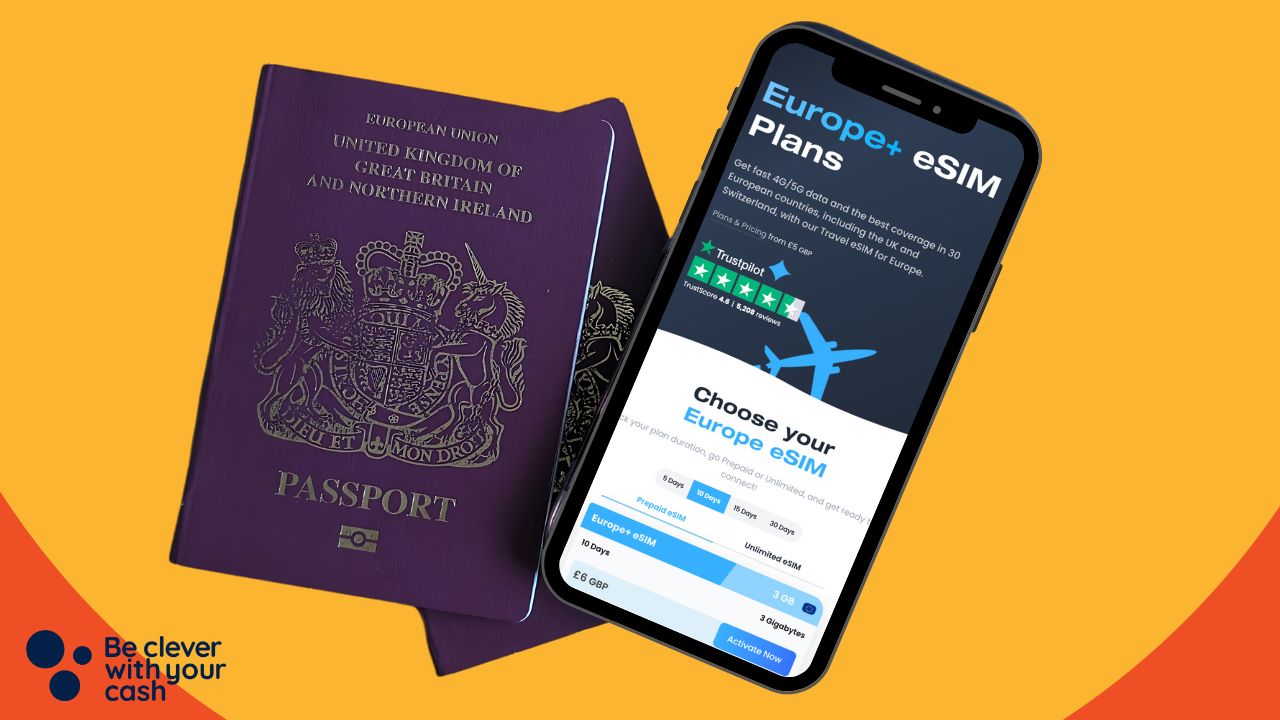
two passports and a mobile phone showing an esim provider

What are eSIMs?

An eSIM is a digital SIM that you can add to your phone. Though some networks have introduced them for your UK SIM, they’re most useful when buying one to use abroad.

Effectively you’re connecting to a local network on holiday rather than the one you use day-to-day at home. You can load several eSIMs at once in preparation for your trip away, which is especially handy if you’re going to multiple destinations. 

The eSIM handles the data, while you can use your regular SIM at the same time for texts and calls. You may have to tweak your settings to share what you want to use each SIM for, then your phone will automatically switch between them for each purpose. 

You usually only get data with these, though some are available for calls and texts too. If you opt for the data only eSIMs you won’t have a local phone number – but you’ll be able to access the internet to use WhatsApp and iMessage to communicate. 

eSIM vs physical SIM

An eSIM is pretty similar to a normal SIM, but the big difference is you don’t need to physically add it to your handset. 

So there’s no need to remove your earring or hunt down a paperclip to pop your SIM tray out, and you don’t need to worry about losing your original SIM while the temporary SIM is in place. 

Plus, you don’t have to search for somewhere to buy one once you land as you can buy your eSIM months in advance. 

But, as you don’t have a physical card, you can’t just pop out the SIM from your phone if you want to switch to another handset — such as if your phone runs out of battery. 

Where can you buy eSIMs?

There are lots of places where you can buy eSIMs, including Maya and Holafly, which offer data-only eSIMs and eTravelSIM, which offers ones with a phone number. The setup is the same, no matter which one you choose. 

Holafly tends to be more expensive as it offers unlimited data. While it can be tempting to go with this option, you’re unlikely to need unlimited data for a couple of weeks abroad. Ofcom reckons the average person uses about 8GB of data in a month, so 3GB should be plenty for a week away, but take a look at your settings to see how much you use.

When buying an eSIM for travel, you can choose the date you plan to fly out and how long you’re away, then the SIM will activate on the day you go away. This means that you can organise your eSIM long before you go on your holiday.  

How to set up your eSIM

iPhone

  1. Buy one online
  2. Go to iPhone settings and search “eSIM” 
  3. Select “Mobile Service”
  4. Select “add eSIM”
  5. Use the QR code and scan the one provided by the mobile network provider
  6. Follow the on-screen instructions

Android

  1. Buy an eSIM online
  2. Go to settings and search “SIMs”
  3. Select the + button to add a new SIM
  4. Select “Set up an eSIM” 
  5. Scan the QR code and follow the instructions

How do eSIMs work?

Once the eSIM is loaded onto your phone, you can just turn it on and off in your settings.

Then, when you go abroad, you can use your eSIM for the data and your regular SIM for phone calls and text messages — this avoids costly roaming charges with your standard provider. 

However, be aware that you might still need to pay for phone calls and text messages if your UK SIM charges for these. You can avoid this by using WhatsApp for calls and messages while abroad. 

To get it working, you just slide the toggle to turn it on and off in your settings once it’s been set up. 

Cost of an eSIM vs roaming charges

You might wonder whether an eSIM is really worth it versus paying for roaming with your mobile network. Here are the costs for the major mobile networks, versus the cost of an eSIM. 

For the eSIM cost we’ve gone with one from Maya with 3GB data for a week away, with the average person using about 8GB each month according to Ofcom. 

Within Europe

O2EEVodafoneThreeeSIM (3GB)
CostNo extra charges £2.59/day or £15 per week£2.57 per day/ £15 for 8 days/ £20 for 15 days£2/day£6 per week
Usage (fair-use)25GBUse your UK allowance25GB12GB3GB
Cost of a week abroad – within allowance£0£15£15£14£6

Outside Europe

O2EEVodafoneThreeeSIM (3GB)
Cost£7 per day£25  £6 – £7.86 per day (depends on when your contract began)£5 per day£7 per week
UsageUnlimitedUse your UK allowanceUse your UK allowanceUse your UK allowance3GB
Cost of a week abroad£49£25£42-£55£35£7

Is my phone compatible with eSIMS?

Your phone needs to have the technology available for eSIMs, which tends to be newer devices. 

iPhones from the XR model and beyond support eSIMs. 

If you’ve got an Android device it’s a little more complicated, but most Samsung Galaxy and Google Pixel phones tend to have it. For other Android devices you’ll need to look up whether your device has it, or search your settings for “eSIM” and see if you have the related settings. If you do, your phone is compatible.

Your phone needs to be unlocked from a mobile network in order to use eSIMs. You can contact your network to unlock it for you if yours is locked or to check if yours is locked.

Can you have more than one eSIM?

Yes, you can have more than one eSIM stored in your phone, though you can only use one at a time. You can have 20 eSIMs installed on an iPhone and about ten on Android phones — for Android this varies.

Should you get an eSIM?

Unless you have free EU roaming, in most cases an eSIM will save you money when headed abroad. However there’s the caveat that you may have a different phone number, or might not be able to take calls for your time away without additional costs.

To find out whether it’s worth it, spend a little time looking at how much your mobile network will charge you when you go away. For example, if you have a contract with O2 and are travelling to Europe, you can use your phone for no additional cost, but it’s one of the most costly networks when travelling to the States (though it is free if you also have Virgin Media broadband).

You also want to consider whether you’ll have access to WiFi at your accommodation, as this could impact whether you’ll need more data than you typically use at home.

Last year, on a two-week trip to Spain, while I was revelling in O2’s free roaming, my partner on EE spent a whopping £25 for two weeks of roaming using his existing SIM. If he’d been slightly more prepared, he could’ve spent as little as £7 for the fortnight of data, and still used his regular SIM for phone calls. 

We also have some tips on reducing your mobile phone bill when going abroad in our full guide.

Cash Chats 474 | Credit score special: Scores & reports explained plus how to give your rating a boost

The podcast to help you make the most of your money

In this rewind special Amelia’s explaining everything you need to know about credit scores – what they are, why they’re important and how to improve your rating. There’s a lot to cover and there are some really useful tips – so hold onto your horses!

Scroll down for further reading links.

Listen to Cash Chats episode 474

Or you can also listen to Cash Chats on all podcasting apps. Click through to your favourite via these buttons:

More from Cash Chats

If this episode has saved you money, please do tell a friend!

It’d be great if you also leave a review and rating. Here’s how to do it on Apple Podcasts and iTunes. 

Don’t forget to join the Cash Chats community on Facebook.

The music used on Cash Chats is Easter Island by Lonely Punk and provided on a creative commons licence.

LTV & the remortgaging tricks that’ll save you thousands

Don’t miss out on even better deals when looking for a new mortgage offer.

If you’re on a fixed mortgage deal, you might just see remortgaging as something you need to do to avoid moving on to a more expensive standard variable rate. Of course, doing that will save you money but it’s possible to use remortgaging to reduce how much you pay over the term even more.

I’m not going to go through everything you need to do when you remortgage here – things like check your credit report for errors, get paperwork together and watch your spending and credit applications in the run-up to your application.

This is all very important stuff and could well have changed since you last got a mortgage. So do read up on all of that.

Instead, I’m going to focus here on a few simple things you can do that could make a big difference to the monthly and total cost of your mortgage. And the main one involves something called “Loan to Value”.

Watch this video or keep reading (or both)

Some articles on the site contain affiliate links, which provide a small commission to help fund our work. However, they won’t affect the price you pay or our editorial independence. Read more here.

What is Loan to Value?

Loan to Value, or LTV, is essentially how much you have borrowed against the value of your house. So if you originally bought a £300,000 house with a £30,000 deposit you would have had an LTV of 90%. That’s a mortgage loan of £270,000.

So why does this matter to remortgaging? Well, LTV is measured in bands. They generally start at 95% (meaning you’ve put down a 5% deposit) and drop in 5% increments down to 60%, though sometimes the gaps between tiers are larger (eg 75% and then 60%).

Mortgage interest rates tend to then drop for each band you move down. And obviously the lower the interest rate you get, the less you’ll pay.

For example, at the time of writing, the lowest available five-year fix is 3.89%, according to mortgage broker Tembo. This is based on taking out a 35-year mortgage term with a 60% LTV. At 75% LTV, the lowest five-year fix available is 4.1%, 4.22% for 80% LTV and 4.32% for 90% LTV.

And over time there’s a good chance your LTV will have changed, meaning you might get a better deal when it comes around to remortgaging.

There are two key changes that could have affected your LTV since you agreed to your last mortgage deal.

Tembo Mortgage

Try our mortgage calculator

Our mortgage calculator helps simplify things by giving you an idea of how much you could borrow and your likely monthly repayments.

How your LTV could have changed

First, unless you’re on an interest-only mortgage, you’ve been paying into your mortgage every single month, building up equity.

Say you’ve knocked £15,000 off the mortgage in equity payments (don’t forget some of your monthly repayments will have gone towards interest charges), then you have added an extra 5% to what you own. This means your LTV would now be 85% and you can apply for the next tier of mortgages.

And second, your property value could have increased. Let’s say it’s now worth 5% more at £315,000. That’s an extra £15k. Alongside your initial deposit and the 15k in repayments, it would give you £60,000 of equity – roughly 19% of the total value. That means the LTV is now 81%. 

However, in the example above, the repayments and extra value might give an LTV of 81% but it would still only mean getting access to deals in the 85% LTV bracket, rather than 80%.

When you’re really close to a new tier, finding some extra cash from savings or cutting back ahead of remortgaging would be well worth it. Here an extra £3,000 might seem a huge amount but the drop down to the 80% band could be a big saver over time.

Using our example mortgage size, a 0.45% difference between 85% and 80% LTV tiers over five years would be just £2,000, but over 25 years that variation in rate would be worth £15,000.

It’s worth having a go on our mortgage calculator to find out what effect things like different rates have on payments, so it’s worth taking a look at playing around.

How to get a new valuation for LTV

You can get a sense of price changes using a site like Zoopla. You put your postcode in and you’ll get an estimate as to the current value of your property. It’ll be shown in a range which can be quite broad. For example, it suggests my house has gone up by £20k to £79k more than we paid for it two years ago.

You can also get an idea from Zoopla and RightMove as to what other similar properties have gone for recently. Have a nose at the listings online so you can see if it’s a similar layout and standard inside. Remember these are just guides.

For a more accurate idea you could invite an estate agent over to give you their input – there’s no commitment for you to list the house if you do this. You can then put a figure on your application. 

The mortgage lender will then want to do their own valuation (and charge you for it!). This could just be a drive-by looking at the outside of the property, or they might want to come into the house. You probably won’t know which one it is, so make sure everything looks good inside just in case. 

This won’t happen though until you’re already quite a decent way through your application process so if you don’t get what you want to bear in mind you’ll start all over again with another lender. 

Shop around for the lowest rate

Once you’ve checked the LTV you could just remortgage with your existing lender. That might be the quickest option, and it could mean you don’t need to go through as many hoops and cut out some fees. But it could also mean you’re missing out on some much lower deals. 

You can find the best remortgage rates on our comparison tables, which are updated in real time and are really handy to get an idea of what’s out there.

You can also talk to a mortgage advisor, who will be able to give you a much better idea of what you could be offered based on your individual circumstances, and even ways to boost your affordability.

A few extras to bear in mind when comparing different rates:

Find out if you are able to overpay 

It’s really worth looking to see what the rules are in terms of overpayment. Some won’t let you do it at all, while others might have annual limits. Best is complete freedom to pay what you want each month and the ability to clear it completely before the term ends.

Even if you don’t think you’ll be able to overpay by much, if at all, right now, you never know how things could change. It’s really useful to have that flexibility.

And overpaying can save you a fortune in interest charges as well as help you clear the debt earlier. There’s more on whether you should pay your mortgage off early here.

Tembo Mortgage

Compare mortgage rates and deals

Looking for a mortgage? Find the top rates from over 200,000 deals and 100+ lenders with our live tables.

Watch out for fees

You’ll get charged all sorts of different fees with different mortgages, and they can make good looking deals actually worse than ones with higher interest.

The main ones are the arrangement and booking fees. These facilitate the deal and could be non-refundable. You need to factor in these to the total cost of the mortgage deal.

Do this over the length of the deal (eg three years) to work out what you’ll actually be paying over time, and compare it to one with higher rates and lower fees.

Consider if you want to fix for longer

If interest rates are going to shoot up in the coming years, you might want to look beyond the usual two-year fixes. There are often five and 10-year options available, though you may pay a higher rate for these.

Check how much you’ve left to pay

One reason not to remortgage is when you’ve almost cleared your debt. That’s because the fees that are added to new deals could well wipe out the savings you’ll make by sticking put – even if it’s at a higher interest rate! So work out how much you’ll be paying by sticking put just in case it works out cheaper.

Featured switching deal
Our top pick
Customer rating 3.8/5
  • Switch bonus
    £180
  • Offer ends
    Unknown
  • Extra bonus
    £25 Amazon Gift Card
  • FSCS Protected? Yes
  • Switch bonus requirements Switch using the Current Account Switch Service and close your old account within 60 days of starting the switch
  • Deposit requirements Deposit £1,500 in the first 60 days from opening the account
  • Direct debits transferred over Set up two Direct Debits before or after the switch from a selected list of household bills
  • Existing customers? Can't have held any Santander current account on 1 January 2025
  • Restrictions Can't have received a switching bonus from Santander already, offer limited to once per person
  • Eligible accounts Open a new or hold an existing Everyday, Edge, Edge Up or Edge Explorer current account
  • £25 Amazon Gift Card requirements To qualify for the gift card, you need to complete a full switch using CASS, and make five debit card transactions within 30 days of opening the account.

When to remortgage

It’s worth looking for new deals around six months before your deal ends as it can take time to get the process approved.

Saying that, you can remortgage at any time, though if you do it before your deal ends you may get hit with exit fees – usually known as early repayment fees.

So generally it’s best not to do it early but you might want to keep an eye on any potential base rate changes by the Bank of England.

If it looks like there’s going to be a significant rise you might want to switch your deal early to get hold of lower price deals – but of course you need to factor in any early repayment charge as well as any changes to LTV.

Important

*Your home may be repossessed if you do not keep up repayments on your mortgage. Be Clever With Your Cash may receive a payment from Tembo Money if you complete a mortgage through the link provided. This will not affect the amount you pay for the service.

This broker fee discount of up to £499 is applicable for standard mortgages and remortgages only, more complex cases including guarantor, buy-to-let, adverse credit, and equity transfer may be liable for a fee. The fee you are required to pay will be clearly outlined by your adviser prior to an application being submitted on your behalf. The offer does not cover any other potential fees that may arise during the mortgage process.

Tembo Money Limited (12631312) is a company registered in England and Wales with its registered office at 18 Crucifix Lane, London, SE1 3JW. Tembo is authorised and regulated by the Financial Conduct Authority under the registration number 952652. Tembo Money was awarded Best Mortgage Broker at the British bank awards in 2022, 2023, 2024 and 2025. Rates are not guaranteed and may change by the time you come to apply. Eligibility criteria may vary by lender.

Our calculator is only an estimate of how much you are able to borrow and does not constitute mortgage advice

Stamp duty: how it works

A guide to the tax that’s charged on property purchases

When you buy a property there are lots of costs to factor into your budget. One of the biggest could be the amount of stamp duty you’ll have to pay.

Here’s everything you need to know about what stamp duty is and how it works.

Some articles on the site contain affiliate links, which provide a small commission to help fund our work. However, they won’t affect the price you pay or our editorial independence. Read more here.

What is stamp duty?

Taxes are as old as time and stamp duty is no exception. Introduced back in 1694, it’s a tax that’s charged on property purchases. Over the centuries stamp duty has had many facelifts, but the concept remains the same: when you buy a property, you may have to pay tax.

In England and Northern Ireland, it’s known as stamp duty land tax (SDLT). In Wales it’s called Land Transaction Tax (LTT) and Scotland has Land and Buildings Transaction Tax (LBTT).

How does stamp duty work?

In most cases, your solicitor will handle all aspects of stamp duty for you.

They’ll calculate how much you need to pay and collect the payment from you before you complete on the purchase. They’ll also send the payment to HMRC, Revenue Scotland or Welsh Revenue Authority on your behalf.

Tembo Mortgage

Try our mortgage calculator

Our mortgage calculator helps simplify things by giving you an idea of how much you could borrow and your likely monthly repayments.

How much does stamp duty cost and how is it calculated?

The amount you pay is dependent on the purchase price of the property, and whether you’re first-time buyer, moving up the ladder, or purchasing an additional property like a second home or property to rent out to others (a.k.a a Buy to Let).

This type of tax is charged as a tiered system based on pricing band levels. The portion of the sale price that falls into each band is then charged at the corresponding interest rate. The less you pay for a property, the less you’ll pay in stamp duty, LTT or LBTT.

If you’re a first-time buyer in England or Northern Ireland, you’ll be able to save on the amount you pay – if the property will be your main residence and the purchase price is no more than £625,000.

As a first-time buyer, you’ll pay no stamp duty at all for properties with a purchase price of up to £425,000. If you buy a property for somewhere between £425,001 and £625,000, you’ll pay 5% of the purchase price in stamp duty.

Unfortunately, there’s no cut for first-time buyers in Wales. But with property prices generally lower than other parts of the UK, many first-time buyers will fall into the exemption band of £225,000 or less.

In Scotland as a first-time buyer, you won’t pay LBTT on the first £175,000, an up-lift on the usual £145,000 band limit.

Here are the current rates and bands (you may qualify for some savings on the amounts shown if you’re a first time buyer)*:

Tembo Mortgage

Compare mortgage rates and deals

Looking for a mortgage? Find the top rates from over 200,000 deals and 100+ lenders with our live tables.

England and Northern Ireland

Stamp duty rates for first time buyers:

Property valueStamp duty rate
Up to £300,0000%
The next £200,000 (the portion from £301,000 to £500,000)5%
Anything above £500,000Normal SDLT rates apply (see below)
Source: gov.uk

Stamp duty rates for non-first time buyers:

Property valueStamp duty rate
Up to £125,0000%
The next £125,000 (the portion from £125,001 to £250,000)2%
The next £675,000 (the portion from £250,001 to £925,000)5% 
The next £575,000 (the portion from £925,001 to £1.5 million)  10% 
The remaining amount (the portion above £1.5 million)12% 
Source: gov.uk

Examples of what you’d pay in England

If you buy a property for £125,000 or less

  • you won’t pay any stamp duty

If you buy a property for £295,000, and you’re not a first time buyer, you’ll pay:

  • 0% on the first £125,000 = £0
  • 2% on the next £125,000 = £2,500
  • 5% on the remaining £45,000 = £2,250

Total stamp duty amount = £4,750 

If you buy a property for £950,000, and you’re not a first time buyer, you’ll pay:

  • 0% on the first £125,000 = £0
  • 2% on the next £125,000 = £2,500
  • 5% on the next £675,000 = £33,750
  • 10% on the remaining £25,000 = £2,500

Total stamp duty amount: £38,750

Wales

Property valueLTT rate
The portion up to and including £225,0000%
The portion over £225,000 up to and including £400,0006%
The portion over £400,000 up to and including £750,0007.5%
The portion over £750,000 up to and including £1,500,00010%
The portion over £1,500,00012% 

Examples of what you’d pay in Wales

If you buy a property for £225,000 or less (regardless of whether you’re a first-time buyer or not)

  • you won’t pay any Land Transaction Tax

If you buy a property for £290,000 (regardless of whether you’re a first-time buyer or not), you’ll pay:

  • 0% on the first £225,000 = £0
  • 6% on the remaining £65,000 = £3,500

Total LTT amount = £3,500 

If you buy a property for £950,000 (regardless of whether you’re a first-time buyer or not), you’ll pay:

  • 0% on the first £225,000 = £0
  • 6% on the next £175,000 = £10,500
  • 7.5% on the next £350,000 = £26,250
  • 10% on the remaining £200,000 = £20,000

Total LTT amount = £56,750

Scotland

Purchase priceLBTT rate 
Up to £145,000 (up to £175,000 for first time buyers)0% 
£145,001 to £250,000 2%
£250,001 to £325,0005%
£325,001 to £750,00010%
Over £750,00012%

Examples of what you’d pay in Scotland

If you buy a property for 145,000 or less, and you’re not a first-time buyer

  • you won’t pay any Land and Buildings Transaction Tax

If you buy a property for £290,000 (and you’re not a first-time buyer), you’ll pay:

  • 0% on the first £145,000 = £0
  • 2% on the next £105,000 = £2,100
  • 5% on the remaining £40,000 = £1,500

Total LBTT amount = £3,600 

If you buy a property for £950,000 (and you’re not a first-time buyer), you’ll pay:

  • 0% on the first £145,000 = £0
  • 2% on the next £105,000 = £2,100
  • 5% on the next £75,000 = £3,750
  • 10% on the next £425,000 = £42,500
  • 12% for the remaining £200,000 = £24,000

Total LBTT amount: £72,350

 *Rates correct as of June 2025

Is there a way to reduce the amount of stamp duty you pay?

The simplest way to reduce the amount is to buy a property in a lower band. But this is of course easier said than done if you need a larger property or live in an area with higher prices.

If the property you’re interested in has an asking price that’s very close to a lower band limit, you could try negotiating with the seller to see if you can strike a deal. Just tread carefully with this approach though as there’s often a lot of competition among buyers, so you’ll need to make sure your offer is still competitive.

Is anyone exempt from paying stamp duty?

There are some scenarios where you’ll be exempt from paying stamp duty. They are:

  • A property transfer where no money or other type of payment changes hands
  • A property left to you in a will
  • A property transferred because of divorce or dissolution of a civil partnership

How does stamp duty differ for buying a second home or buy-to-let property?

If you’re buying a second home or a buy-to-let property in England or Northern Ireland, you’ll usually have to pay at least 5% extra on top of the usual stamp duty rates.

In Scotland, the extra amount you’ll pay for a second property is at least 8% of the purchase price and in Wales, it will be at least 2% to 5% extra.

Our podcast

Listen to Cash Chats, our award-winning podcast, presented by Editor-at-Large Andy Webb and Deputy Editor Amelia Murray.

Episodes every Thursday.

Andy and Amelia with the text "Cash Chats Personal finance podcast"

Does stamp duty apply when buying shared ownership?

Yes, you’ll still have to pay stamp duty when you’re buying a shared ownership property. But this has a little more flexibility as you can choose whether to make a one-off payment based on the market value of the property or pay it in stages.

How long do you have to pay stamp duty after buying a property?

When it comes to making the payment, the rules are the same wherever you are in the UK. You have a 14-day deadline from the completion date to make your payment. Most solicitors will collect the payment from you in advance so they can make sure everything is paid on time.

As with anything tax and Government related, the rules on limits, rates and exemptions are always subject to change. Before you go ahead and put an offer in on a property, it’s always best to speak to a solicitor about your situation so they can help you understand the land tax implications and how much you’re likely to pay. The official Government websites for your part of the UK will also have the most up-to-date information. 

Important

*Your home may be repossessed if you do not keep up repayments on your mortgage. Be Clever With Your Cash may receive a payment from Tembo Money if you complete a mortgage through the link provided. This will not affect the amount you pay for the service.

This broker fee discount of up to £499 is applicable for standard mortgages and remortgages only, more complex cases including guarantor, buy-to-let, adverse credit, and equity transfer may be liable for a fee. The fee you are required to pay will be clearly outlined by your adviser prior to an application being submitted on your behalf. The offer does not cover any other potential fees that may arise during the mortgage process.

Tembo Money Limited (12631312) is a company registered in England and Wales with its registered office at 18 Crucifix Lane, London, SE1 3JW. Tembo is authorised and regulated by the Financial Conduct Authority under the registration number 952652. Tembo Money was awarded Best Mortgage Broker at the British bank awards in 2022, 2023, 2024 and 2025. Rates are not guaranteed and may change by the time you come to apply. Eligibility criteria may vary by lender.

Our calculator is only an estimate of how much you are able to borrow and does not constitute mortgage advice

Our deals of the week 20 June 2025

Our pick of the best offers and savings.

Every week we spend hours looking at discounts and deals to pick the good from the bad. We’ll only share ones which we think are worth considering – but remember you’re only saving money if you’re buying something you need and can afford.

Some articles on the site contain affiliate links, which provide a small commission to help fund our work. However, they won’t affect the price you pay or our editorial independence. Read more here.

This week’s deals

Bill’s: £5 bottomless pancakes

For just £5, you can get bottomless buttermilk pancakes when you buy any drink on Fridays throughout June. You can choose from two different types of toppings, and you have 90 minutes to enjoy them.

Vision Express: free eye test

If you have the Lidl Plus app, you can get a free eye test and 30% off when you spend £50 on glasses or contact lenses at Vision Express.

Odeon: Two tickets for £8

If you’re a Voxi Mobile customer, you can get two ODEON tickets for £8 in the new monthly rewards scheme.

Tennis: free sessions for kids

Tennis for Free is offering free tennis sessions at around 40 locations across the UK, with some for kids aged 12 and above and others for all ages.

Co-op: deal stack

There are multiple Co-op deals available at the moment, including £10 off a £40 spend for members, the ‘Spin to Win’ game, and a possible £5 Costa voucher.

Art Pass: discounted entry for 3 months

Until 30 June, you can get a 3-month National Art Pass for £15. It’s unusual to get a pass for less than a year, so if you want to try it out this is your chance!

Barclaycard: cashback doubled

Until 30 November, new applicants to the Barclaycard Rewards card (those who join before 4 August 2025) can get boosted 0.5% cashback rather than the standard 0.25%.

The Ivy: £20 off £100

Until 30 June 2025, you can get £20 off a £100 spend at The Ivy or The Ivy Asia restaurants when you book via a particular link.

Currys: £10 voucher for old electronics

Take old electrical items to Currys to be recycled and you’ll get a voucher for at least £10 off when you spend £25. You can bring anything that’s powered by battery or mains, whether it’s working or not, and it doesn’t have to be from Currys originally!

Decathlon: return used tent for gift card refund

Some 250,000 tents are left at festivals each year. In an effort to reduce waste, Decathlon’s ‘No Tent Left Behind’ campaign lets customers buy a tent, use it for a few months, and then return it for a gift card refund.