



Can split tickets really cut the cost of train fares?

Ticket splitting, where you buy individual tickets for parts of the journey rather than just one return, is hyped as a top way to save on trains. 

For years this has been a slightly hidden trick, requiring guesswork on your part or using a small website to work out where to break a ticket. But now booking giant Trainline has got in on the act, and Virgin Rail will launch a booking service doing the same later this year. This trick could be about to go mainstream. So just how likely are you to actually find a fare this way?

First up, it absolutely can work – you might have seen the stories online of people managing to massively cut their train fares by doing it. My favourite was one a few years ago where a guy saved a ton of cash but had 28 separate tickets for his journey

But in my experience, it’s rare that a journey comes up costing less with this method. In fact, I’m not sure I’ve ever actually cut the cost of my own journeys through splitting, at least not that I can remember.

It could just be because the routes I take aren’t long enough, or perhaps it’s the times I travel. As a method of saving cash it seems only marginally more reliable than a Thameslink or Northern train service.

So if you do manage to nail down a split fare then it can make a big difference. Just don’t expect to do it for every journey. To help you I’ve taken a look when there’s potential to save, and when it’s less likely to happen.

What is split ticketing?

Very simply you buy a series of tickets rather than just one for your journey. So a train from London to Newcastle could be cheaper if you get a ticket from London to Doncaster, change train, and then get another ticket from Doncaster to Newcastle. With some journeys, you can even stay on the same train. Maybe even in the same seat!

When split tickets are more likely

Yep, it’s weird and there’s no obvious logic behind when you can get split fares and when you can’t. However there are factors which could help you find one of these cheaper fares.

When part of your journey is peak and part is off-peak

Peak trains are almost always more expensive, but if you are able to split the journey so you’ve got a different ticket once rush hour finishes it could save cash.

When you’re going a long way

Again, you’ve more opportunities for change if you’re going through more stations, and that could bring up a few splits.

When you’re using different train providers

If you change trains part way and the second train is operated by a different train company then it’s definitely worth seeing if splitting the fare works. Look out too for promotions exclusive to one route. Though not strictly a split fare, I recently got 10p returns to Leeds from Manchester in a flash sale, but I’m paying the normal return price to Leeds from where I live.

When you’re buying last minute

The more expensive the total fare, the better your chance of finding some cheaper options through splitting. Of course, it’s better and cheaper to book in advance, but we’ve all had times we can’t plan ahead.

When you’re looking at single journeys

I’d always check for splits on a single journey rather than a return as it gives you the flexibility to find different splits each way. Of course, compare this to the price of a standard return.

When you’re willing to make a few changes

It won’t necessarily be the quickest route, but if you split up your journey along a less direct route then there could be more opportunities to split.

When split tickets are less likely

This seems to be my experience. Sadly, there are lots of journeys where you won’t find any split savings. Obviously the opposite of the above reduces your chances of savings, and I think it’s incredibly unlikely for short trips, and ones with few stops on the way.

How to find a split ticket

You’ll probably need to get online, though that’s not to say station staff won’t know a few savings – it’s just unlikely.

You can of course work it out yourself by checking the stations on the way and seeing if breaking the journey, whether on the same train or a different one, brings up cheaper tickets.

But the easy way to find the fares is to use a split ticket website. These take your journey and work out the cheapest and quickest split (or splits) possible – if there are any. 

I’ve looked at a few (long) journeys on each of them and had different results, so if you can spare an extra couple of minutes it’s worth doing a couple of searches.

Each of these, including Trainline, charge you extra on top. Some include this in the price you see, others add it on. Trainline, which charges a flat £1.50, works out cheapest if your saving is more than £15. The others all charge 10% of the saving, which could be quite hefty on journeys with large savings.

If you don’t want to pay these extra fees you can buy the tickets through another train booking website. However, if you can afford it you might want to pay to help the smaller services survive, especially if you’ve got a substantial saving.

Risks of split tickets

A problem could occur if you have to make any changes on your journey. With a standard ticket taking you from station A to station C via a change of trains at station B, you’d be able to get on a later service if the first leg is delayed.

But with split tickets covering stations A to B, and then stations B to C, you’d likely have to pay for a new ticket from B to C if you miss the pre-booked train, though you would be able to get a refund on the first train if it’s more than 15 minutes late.

Don’t forget to add in the other tricks to save on train journeys such as railcards and advance fares. More here:

Cash hack: 10 tricks for cheaper train fares


Tricks to afford an annual rail season ticket

Save hundreds of pounds on your rail commute by spreading the cost of an annual season ticket.

Every January trains fares jump up, and 2020 will be no different. It’s been announced tickets will go up by an average of 2.7% from January 2nd. And even though it’s less than the increases in 2018 and 2019, it’s still a harsh increase for many frustrated train travellers.

The same tricks will apply to cut your fares, such as buying in advance or splitting the ticket, but what about regular commuters?

Well, the best way to pay less is usually to buy a season ticket, with a 12-month ticket offering the biggest savings. BUT these annual passes require you to stump up a lot of cash upfront. And that’s not easy for everyone.

Will a season ticket be better for you?

In most cases, a season ticket will be cheaper than paying day-in, day-out. It’s worth taking five minutes to work out the cost of your commute to see what savings can be made. Remember, you won’t actually be going every day, so account for weekends and holidays.

It won’t be the best option for everyone though – especially anyone part-time For most of my working life I’ve bought an annual season ticket. But when I reduced my time at the day job a couple of years ago doing this no longer made sense.

When to get a season ticket

If you haven’t got one and are thinking about it, get it before January 2nd so you can avoid the fare increase. However, even if you buy it before this date, if it starts from the 2nd onwards you’ll still pay the new higher price.

Timing your season ticket

Of course, if you already have one then you can’t buy it to beat the increase and will have to wait for renewal. It can sometimes be worth timing when you buy your season ticket, and possibly getting a week or month-long passes to keep yourself going. For example, If the dates worked, I always used to time my holiday close to the end of a season ticket, and start the new one when I returned.

Ways to spread the cost of an annual season ticket

Find out if your work will give interest-free free loan

This is usually the best option – if your work offers it. It’s better than using savings too, as you can leave that money earning interest elsewhere.

Here’s how it usually works:

  • You fill in an application form with your HR dept. Expect to provide proof of the season ticket cost. You can also usually choose how many repayments you’d like to make.
  • Once it’s been signed off, the full amount is paid to your bank with your salary
  • You’ve then got the cash to buy the season ticket
  • Each month the loan will be taken from your pay before it gets to you.

Use a 0% interest purchase credit card

As with any big purchase you don’t have savings for, a 0% credit card helps you spread the cost. Don’t forget that you are borrowing money, so you need to make sure you pay off the debt to avoid high-interest payments when the promotional 0% period ends. You’ll also have to make at least the minimum repayment every month. Personally I’d pay it off as quickly as possible.

Try a commuter club

These are loans on annual season tickets, with payments spread out over 10 or 11 months. You will pay interest, but it’s still cheaper than buying monthly season tickets. The main one is Commuter Club.

Opt for monthly or weekly season tickets instead

If you can’t do any of these, then most of the time you’ll still save money with a monthly, or even weekly, season ticket.

However, if you are in London and use pay as you go via Oyster or contactless there are daily and weekly caps. These usually work out better than weekly season tickets You can see the different fares and caps on the TFL website.

Extra season ticket benefit in the South

Something I really miss about my annual season ticket is the free Gold Card. This railcard gave me a third off most fares in southern England for you and up to three other adults. You get this with a TFL season ticket too, not just mainline rail.

Once you have it you can also buy a different railcard for £10 for a friend or family member.

My tricks to cut the cost of train tickets

You can read more about these and other tricks I use to make train travel vaguely affordable in my 10 tricks for cheap trains guide.


Time to talk about death and money

You need to make plans and have a conversation about what will happen to your finances when you die.

Very little seems taboo nowadays, but a couple of things people tend to avoid talking about are money and death. And even more so when those two things are combined.

It’s understandable. No one wants to consider losing their loved ones, so if you don’t talk about it you can avoid the idea that it’ll ever happen. And to discuss money in the same context does seem like bad taste.

But this conversation is vital. When someone dies, dealing with finances is one of the last things loved ones want to do, and it can even lead to greater distress if funds are frozen and income drops.

So anything we can all do beforehand will be a huge help – and the first step is to talk about it. I’ve done this with my parents, my wife and my sister too.

This isn’t just about inheritance (though that’s still very important). It’s also about how bills, funeral wishes, debts and more.

And everyone needs to do this, whether you’re young or old as you don’t know what could happen.

You can also listen to my discuss this topic on my Cash Chats podcast

How to start the conversation

This probably isn’t one chat. You’ll want to talk about your own wishes and situations, but potentially also ask your loved ones about their plans.

It’s important to have these chats with everyone who could be affected. So start with your partner so you both know the situation. Then once you both know what you want, talk to your parents or your grown-up kids – or both.

Though I think it’s better to do this in person so you can take visual cues on this tough conversation, you don’t have to. And with so many of us now able to use video chats it might be almost as good an option. Do check if it’s a good time to have a talk too.

You might want to start the chat by asking them have they thought about it, and stress why it’s so important. If they haven’t then it’s probably best to give them a few weeks to consider what they want.

Remember a big part of a conversation is listening, so be sympathetic and don’t be judgemental. 

If they really don’t want to talk about it, don’t be too pushy, but explain to them why it’s really important to at least consider what they want and put it in a will.

What to talk about

These are the key topics to talk about. 

Funeral wishes

Whether you want to be buried or cremated, funerals can be very expensive. The average basic funeral now costs £4,417 according to SunLife. And it’s a lot more in London, where the average is £5,693.

Though cremations are cheaper, you’d still need to find an average of £3,858 for one that includes a service. It’s all really pricey.

Remember this is just “basic”, so it could be higher still when you add in things like limousine hire, food for a send-off and flowers.

So all very expensive, and not everyone will have money in their estate to cover these costs. And even if they do, these funds won’t necessarily be available to pay the costs at the time. 

Which means there’s a very good chance loved ones will have to use their own money if they have it, or borrow money if they don’t – which can lead to debt.

One way you can help now is to think about what you’d actually want, and then discuss it with your family. If you are happy with something basic then say. If not, it’s easy for grieving loved ones to avoid some cheaper options which might be perfectly fine.

When my gran died 10 years ago I took on things like choosing the coffin and stone so my mum didn’t have to. There are so many different options at a huge range of costs. I can see how easy it would be to go for a higher specification. It would have been so much easier if I’d know what my gran would have liked.

You could also look at a funeral plan where you prepay, though these aren’t without their own pros and cons. Here’s a really good guide and cost comparison from Money Saving Expert.

What happens if you get seriously ill

It’s not just dying that could impact your finances and your family. Think about what you want to happen if your body or mind deteriorates to the extent you can’t look after yourself.

This can range from whether you want to be resuscitated through to whether you’d want to be cared for at home.

It’s worth having a power of attorney in place while you’re full with it mentally so you can be sure someone you trust is able to make decisions on your behalf.

Children

If you have kids that are still at home you need to make plans for who will look after them until they are 18 if you and your partner both die at the same time. 

You’ll need to ask family or friends to agree to be legal guardians, and then put this into your will.

Inheritance

It’s your money, and you can do what you want with it so this isn’t necessarily something you have to talk about with your wider family. But you absolutely should discuss this with your partner and work out together where you want everything to go.

It’s also an opportunity to plan around inheritance tax as there are things you can do to minimise how much of your estate is lost in tax.

What you need to do

Once you’ve had a chat about these topics, you can then take a few actions that’ll make it easier to deal with money matters when you do die.

Sort out a will

This is the most important one. In fact, even if you can’t bring yourself to have the chat, at least get it down on paper. It not only makes it easier for everyone, it also means your money will go where you want it.

Without a will your estate (i.e. everything you own including property, savings and possessions) will go be distributed according to the law. For example if you’re married most will go to your spouse. But if you’re not, long-term partners could miss out completely.

You can make a will yourself for free, or use an online will-writing service relatively cheaply, and if it’s really simple there’s no reason to not do this.

But if anything is more complicated then you will probably want to talk to a solicitor. There are a couple of ways this can be done for less, including Free Wills Month in March and October and Will Aid in November.

We did the latter last year in exchange for a charitable donation and the process really made us think about what we wanted.

This guide from Which? magazine takes you through the different will options.

Consider life insurance

Now you’ve been thinking and talking about death, it’s logical to see if you can afford life assurance. This is an insurance policy which in exchange for a monthly fee will pay out a lump sum on death.

This is actually a lot cheaper than you might think. I used to have this via my work, but once I went freelance I took out a personal policy.

List your bills and accounts

This is really important if you’re the person who tends to deal with most of the bills at home, but you should list all your different bank and pension accounts too.

There are two reasons for this. First, if you have anyone else in your home they’ll need to make sure they can pay the bills, then transfer them over to their name. 

Second, you don’t want them to miss out on a savings or pension pot. If these are all written down in a list then it makes this so much easier at what will be a horrible time. 

So write down the account and customer numbers, but be careful about listing passwords. You could look at using a password manager to help keep those secure.

Don’t forget to also include any debts – they’ll need to be paid out of your estate so if loved ones know they exist they won’t be surprised later on.

Oh – and make sure people know where to find this list (and your will).

Make sure your partner has access to money

When you die, your bank accounts will be frozen while the estate is being sorted according to your wishes. But if you have all the money in your account that could mean your partner has limited access to cashflow – and this can last a while.

So, open up a joint account and make sure there’s always some money in there. If you can, it’s worth having a joint account or joint savings account with funds that aren’t touched. Here’s more on the good and bad of joint bank accounts.

Share the workload

Similarly, you need to make sure you both have access to bills.

Because of what I do, I’ve tended to be the one who looks after most bills and bank accounts. Yes it means I can get the best deals and rates, but the downside is that my wife isn’t as on top of everything as she would like.

So we’ve made sure to split some of the bills between us, and wherever possible to have them in joint names.

If you haven’t done this yet, it’s worth doing that now, and helping your partner know what’s what and why.

Budget 2020: What it means for you

Sick pay if you self-isolate or get coronavirus among the big announcements in today’s budget.

Brexit and elections mean it’s been a while (17 months!) since we had a full budget, but Coronavirus and the reshuffle last month mean this Budget was always going to be one low on announcements that’ll impact our day-to-day finances.

Even so today the new Chancellor Rishi Sunak delivered some useful things for know, especially relating to sick pay and Covid-19 and support measures for the high street – though it’s not clear how it’s all going to be paid for.

Here’s are the key things that could make a difference to you.

Coronavirus and sick pay

The government will cover small businesses (less than 250 employees) to fund Statutory Sick Pay for staff who are forced to self-isolate due to coronavirus for 14 days. 

This SSP will be available from day one rather than the standard day four. Bear in mind here that SSP is £94.25 a week (though your employer could choose to pay you more) and you are only eligible if you earn at least £118 a week.

Those who are self-employed or are low earners and are forced to self-isolate they’ll be able to apply for Universal Credit or Contributory Employment and Support Allowance. They can do this online rather than visit a jobcentre and get advance payments upfront rather than wait for the usual five weeks.

There will also be a £500 million hardship fund available to local authorities to use, largely to fund Council Tax relief.

And the NHS will have support “whatever it costs”  in the fight against the spread of the virus.

National Insurance

We’ve known about this for a while. The threshold where you start paying NI will increase from £8,632 to £9,500 from April 6th 2020. 

This means a typical employee will be better off by £104 a year, or £78 if you’re self-employed.

Tax changes

There will be no increase on duty (i.e. tax) on fuel, beer, spirits, cider and wine. 

VAT is going to be dropped on digital books, magazines or newspapers from December 2020. Printed publications are already VAT-free.

And another we’ve known about for a while is the axing of the 0.5% VAT on female sanitary products, aka the tampon tax.

Savings

There was very little to boost savings, which will be made worse by today’s interest rate cut, but the allowance for a Junior ISA will increase to £9,000 – more than double the current £4,368.

Wages & benefits

Something already announced was that the National Living Wage – which isn’t actually anywhere near to a real living wage – will increase in April from £8.21 an hour to £8.72. New though was the ambition to extend this to 21-year olds by 2024.

The benefits freeze will also end meaning from April payments will increase by 1,7%.

Debts

A  breathing space will be introduced from early 2021 that’ll mean people with unmanageable debts can hae 60-days where interest and fees are frozen. Again, this has already been announced but it’s included in the Budget papers. 

The high street

Business rates abolished this year for businesses with rateable value of less than £51,000. So shops, cinemas, restaurants and music venues will benefit, along with museums, galleries, theatres, gyms and more. That’s estimated by the government to be worth £25,000 a year to each small business.

Pubs will also get an increased business rates discount this year, growing from £1,000 off to £5,000 off. 

Motoring and travel

£500 million to make sure more rapid charging hubs are built so drivers are never more than 30 miles away from a charge point for their car.

There’s also going to be a fund to fill 50 million potholes and money towards road and rail improvements.

Do you really need to switch bank?

I’m a huge fan of moving from a bank that does nothing for you to one that will give you something back. But do you need to switch?

The latest figures show 6.3 million bank switches have happened since the 2013 launch of the new system and guarantee, with more than million taking place in 2019 alone.

But with a population of 52 million adults, and assuming some people are like me and switching more than once, that leaves a lot of people who haven’t done it.

Is switching bank a good idea?

So should you switch? Well, first of all, how is your relationship with your bank right now? Is it good? Are you getting any extras from them? If so it might not be the best option to switch to a different one.

You also need to consider the impact of ditching your old bank on your credit score. Having a long relationship with a single financial institution can be really important, so moving bank before you’re about to apply for a mortgage isn’t the best idea.

On the other hand if it’s a one-way relationship with you getting nothing in return, or worse a bad experience, then moving your bank can be well worth it.

Though in truth it’s not so cut and dried. In fact whether your bank is great or a bit of a dud, you could get a better deal elsewhere. For example you could make more money from interest on your account, or you could reduce how much you pay on overdrafts or overseas spending.

Alternatively, you might find that with so banks closing you want to have your cash at a brand that has a branch near you. Perhaps you want to try out some of these new digital app-only banks that promise to help you keep track of your spending.

All good reasons to try something different, and I’ll go through my thoughts on these and more below. You can also listen along via this episode of my Cash Chats podcast.

How switching works

When you perform a full switch you have to close your old account but your payments are moved for you and there are guarantees in case something goes wrong. There’s more information on how this works here.

[mv_video key=”kg5h1rp0wnso70ln86lf” volume=”70″ aspectRatio=”true” title=”How to switch your bank account (and why you need to do it)” thumbnail=”https://mediavine-res.cloudinary.com/v1574194032/kupkum61vahxv97nshbe.jpg” jsonLd=”true” doNotOptimizePlacement=”false” doNotAutoplayNorOptimizePlacement=”false” sticky=”false”]

The thing is, with the majority of the reasons to change bank you don’t actually need to switch. You can just open up a new account. In fact there’s no reason why you can’t open as many as I have.

And there’s a third option, known as a partial switch. With this method you can choose which payments are moved to the new account – and you can keep your old account open.

Whichever option you go for, make sure you check the requirements for the new account to ensure you get the bonus/interest/reward etc. You might need to pay in a set amount every month or have a couple of direct debits come out of the account. Get this wrong and you could miss out.

Reasons to switch

Switching bonuses

These are the big reasons people switch bank. In the last three months of last year the biggest gains from switching were at HSBC, First Direct and M&S with 46,118 people moving over. I don’t think it’s a coincidence that they all offered bonuses.

Now these bonuses, which can range between £50 and £175 are only offered if you go through with a full switch. There have been far less of these recently that at other times over the last few years.

Right now only HSBC and First Direct offer a straight bonus, while Nationwide and TSB are giving away a referral bonus. That means nothing from Natwest, M&S Bank, Barclays, Halifax or Lloyds, who have all offered free cash recently. These can and do change on a regular basis so check out this page where I’m always updating what’s available.

Now that could be a sign that we’ll see less of these incentives going forward. Or we could see the others bring back offers in the coming months.

Personally I would take advantage of as many switching bonuses as possible. Once you’ve got the money you don’t need to stay, you can switch again.

If you’re not keen on closing our existing account to do this then you could just open up an account at another bank and use that as a “switching account” – i.e. one that’s just there to get the bonuses and not your real banking.

Verdict: Switch

Overdraft charges

You can’t have missed that there’s been a big shakeup in the world of overdrafts. The idea behind the changes was the banks would set a simple rate for the overdraft charges so people could compare and switch if they wanted to get a better deal. Great idea.

But what’s happened is everyone has come in with very high and very similar rates: Here’s what they’re charging or will charge by spring 2020.

  • Nationwide already up to 39.9%
  • First Direct, HSBC and M&S Bank will also charge 39.9% from mid-March, and Santander from April
  • Barclays increases to 35% in late march
  • Natwest, and RBS will charge 35% from the start of April
  • Starling will charge either 15%, 25%or 35%
  • Monzo will charge either 19%, 29% and 39%

The banks say most overdraft users will be better off, particularly those who just dip on occasionally. But people with a large consistent overdraft could see charges rocket.

Either way, it now seems like it might actually be pointless to switch in order to cut your overdraft.

However, there are a couple of options worth considering, and I’d say you should switch to them as they also come with a £100 bonus or referral bonus.

They are the Nationwide FlexDirect account which gives 12 months 0% of around £1500, though there’s no guarantee you’ll get that, or the First Direct 1st Account which comes with a £250 buffer.

However if you have an overdraft it’s better to clear it, perhaps with a 0% money transfer cards.

Verdict: Switch

Interest rates

Some of the best interest rates right now are via current accounts.

  • Nationwide FlexDirect offers 5% on balances of up to £2,500 for one year (worth up to £125)
  • TSB Classic Plus gives 3% on balances up to £1,500

There are also regular savers offering 2.75% with HSBC, First Direct and M&S Bank.

Once more I’d say it’s worth switching to all of these, other than M&S Bank right now, as you can also take advantage of a bonus.

Verdict: Switch

Rewards

Many banks offer a monthly reward with some accounts, often in exchange for a fee. Vitally, to get these rewards you don’t need to switch. You can just open up a new account.

The best of these is the Santander 123 Lite, which charges £1 month but in return you get cashback on your bills. It’s capped at £5 though most people will be looking at a profit of £5 or so. It’s possible to run a partial switch which will move over direct debits you select and let you keep your old account open.

Lloyds’ Club account is also a good one to get as you can claim six free cinema tickets or a year-long subscription to magazines such as Empire. In late 2019 Lloyds did offer a £125 switching bonus – the first time it had offered this. There’s always a chance it could come back.

The others aren’t worth a huge amount over the year, and probably not even worth opening an account for. However if you already have these accounts you should be taking advantage of the offers.

  • Barclays Blue charges £4 a month but gives £7 back if you have two direct debits going out (occasionally this is doubled to £14 for new customers).
  • Natwest and RBS charge £2 a month and give £5 back (the cashback on bills was scrapped in February 2020).
  • Co-op Bank offers money back depending on how much you use the debit card
  • Halifax Rewards are worth £2 every month

Verdict: Open a Santander 123 Lite and go for a partial switch, Switch to Lloyds if there’s a bonus.

Packaged accounts

These premium accounts can come with a hefty fee, often between £13 and £18 a month. But in return you get things like travel insurance and car breakdown cover. The price for these via the packaged account can often work out as a lot less than buying them separately.

But you also don’t always need these extras. I’ve never had one as I’ve never needed each of the parts and it’s been cheaper for me to buy what I did need separately.

Now if you do have one of these already and think it’s good value, do shop around just to check you can’t get a similar but cheaper offer at a different bank.

Verdict: Open if you need one and it’s good value. 

Fee-free spending overseas

Most of the new banks such as Monzo and Starling offer fee-free spending and cash withdrawals overseas. My pick is Starling where there’s no cap on your how much money you can take out each month. And you can just open up this account – there’s no need to switch.

Verdict: Open

Budgeting features

These new banks also have a great reputation for the budgeting and savings features built into their apps. In fact, Monzo had the second-largest net gain in the last three months, up by 21,576. Which shows how popular they are.

But once more you don’t need to switch to try this out. Open an account, transfer some cash over and see how the features work for you. You can easily perform a partial switch if you want.

Verdict: Open

Bank branch location

Finally, with so many bank branches closing (more will go this year), you might want to move bank to whichever one is still on your local high street. Again, you don’t need to switch for this, unless there’s also a bonus for doing so.

I’d open up the new account, perform a partial switch over and then potentially use the now useless account to harvest as many bonuses as possible.

Verdict: Open

The best bank switching offers

Deals can come and go, so I’ve got a separate bank switch offers page which I change every time there’s a new deal or an old one goes. It includes the best cash bonus incentives, as well as the highest interest rates and other rewards available.

The best bank switching offers (May 2025)

How to watch classic gigs for free online

How to find performances from the likes of Bowie, Beyonce and Billie Eilish to enjoy from the comfort of your own home.

Festival season would normally be kicking off about now (mid-May), but all of them have been cancelled (or will probably be) for this summer, along with any other live music concerts. 

And it’ll be a long time – potentially 2021 – before we get to attend any gigs or concerts again. I saw classic Britpop band Supergrass a few weeks before lockdown came in, so at least I managed to get a gig fix in this year.

Yes, there could be innovations that allow us to experience some kinds of live music while social distancing (there’s been a drive-in concert in Denmark), but these aren’t going to widespread.

So what’s the alternative? Overall, the best place for us to get the live music experience is probably going to be in our homes.

There have been a number of live performances on platforms such as Instagram and Facebook. They’re largely musician in their bedrooms gently belting out low-key acoustic numbers. Which are fine. But I much prefer something closer to a proper live show.

So I’ve been dipping into archive shows online and watching classic concerts on my TV.

Where to find free concerts & replays online

There are so many concerts out there you just need to get searching on one of the following platforms.

I’ve compiled a list of 50 performances which I think are worth watching. I’ve tried to cater to lots of different genres and tastes (including artists I know are popular but not really to my taste) so there’s hopefully something for everyone.

I’ll also share the best of any new shows announced in my weekly Cheap Night In round-up articles.

BBC iPlayer

For the last five years or so, I’ve had my own mini-festivals at home using concerts broadcast on BBC iPlayer such as Glastonbury and the 6 Music Festival.

These have been great, but tend to disappear after 30 days leaving a limited selection outside the summer.

BBC4 does tend to broadcast the odd classic concerts through the year so it’s always worth a look to see what’s available. The BBC has promised to show loads of classic Glastonbury shows at the end of June in lieu of the proper festival.

YouTube

During lockdown many artists (or their estates) have been releasing performances on their own YouTube channels, including Radiohead and Prince. 

And this discovery has led me down a few online rabbit holes. There are thousands of archive performances uploaded to the internet – and since lockdown began I’ve spent hour after hour watching all sorts of classic performances.

I’ve been able to catch some of my favourite bands, plus watch artists in their prime with shows from the 60s, 70s and 80s. A limited release Prince show last week was the highlight.

Watching a classic Prince concert on YouTube at home during Lockdown

Gigs on paid for streaming services

There are also a number of concert films on Amazon Prime, Netflix and Sky Arts (available on NOW TV and Sky TV). 

These are subscription services so you will pay – but are worth checking out if you already have them. There are also ways to save money on each of these platforms.

Netflix

Netflix has the smallest selection but they are newer shows from the likes of Beyonce and Taylor Swift. 

Amazon Prime

Amazon Prime has concert films from mainly older acts. It’s harder to filter searches here to just live performances so it’s trial and error whether you’ll get a gig or a documentary.

Here’s a search for the word “live” in the music genre for titles included for free with a Prime membership.

Sky Arts / Now TV

The biggest selection is via Sky Arts, but again most of the performers are from the 90s and earlier, even if the performances themselves are more recent.

The cheapest way to get this channel is to ditch your Sky or Virgin subscription and instead get a monthly pass from Now TV. 

How to watch the concerts at home

Obviously you can watch all these streaming services on your computer or via an app on your phone or tablet. But the best way to watch is going to be on your biggest screen with the best sound – which probably means your TV.

Most smart TVs, set-top boxes, games consoles and even newer DVD/Blu-Ray players will have a YouTube app making it really easy to stream on your telly. Whether you have the Netflix, Amazon Prime or NOW TV apps is hit and miss depending on your device.

If you don’t have any of these you can buy a smart stick to plug into a spare HDMI slot. Whichever device you use you’ll obviously need decent broadband.

Some of the videos will have adverts. Most of the time an advert is only “pre-roll” which means it’s at the start of a video.

However, sometimes it could appear mid-way through, and even on multiple occasions. If this bothers you there is the option to take out a 30-day free trial of YouTube Premium, which will allow ad-free viewing. 

Deciding what to watch

Obviously my list will have some gaps, possibly your favourites, so I’ve got a few tips to help you find more.

Filter your searches

On YouTube select the filer tab and you will be able to just see videos over 20 minutes long on your search results. 

Check the quality

I found quite a few concert videos listed which are just recordings from the mosh pit via a mobile phone. It’s not always clear this is the case until you watch them, so check them before you get excited about what you’re going to watch.

Finding out which songs are played

Sometimes you might only know a band’s early stuff, or perhaps you don’t want to sit through a three-hour concert (Hello Bruce Springsteen and Led Zeppelin!). 

Well if you’re lucky, a handful of the videos on YouTube will not only list the songs played but also provide the times so you can skip ahead.

If not you can use the website Setlist.fm to see what songs are played on a particular gig. Armed with this you can pick one gig over another, or fast forward between songs.

Curating your own festival

if you’ve ever enjoyed the pub chat with friends to decide your “Fantasy Festival” lineup then you have the chance to curate your ultimate day of bands – and actually watch them!

YouTube has a playlist feature where the next video will autoplay. I’ve used this to compile a list of those I want to watch, and put them in the order I want them to play.

If  you want to take it a little further I also found this website that will allow you to generate your own festival poster based on the bands you’d want to see.


My fantasy festival line-up with gigs I can watch online for free

Is it legal to watch these videos?

If you’re streaming on iPlayer, Netflix, Amazon Prime or NOW TV then everything is absolutely above board. It’s less clear cut on YouTube.

Most of the concerts you find there aren’t official uploads by the artists, labels or events. Instead someone has just posted a copy they don’t have the rights to.

However, YouTube does have some clever licencing software and most copyright holders can demand videos are removed.

On that basis, try as much as possible to only watch those videos which at least have an acknowledgement of copyright and licensing. 

This should mean the artists will get some payment. But if you want to make sure artists are properly remunerated then you can always choose to subsequently buy an album for any of the gigs you watch.

You could also argue that if a video has been left on there for years that the copyright holders aren’t overly worried.

50 live concerts you can watch online

To get you started I’ve looked through all the platforms to find a selection of bands and artists from The Rolling Stones to Taylor Swift to The XX all available to watch right now

How to watch classic gigs for free online

Happy 2nd Birthday Be Clever With Your Cash

Celebrate with some of the blog’s biggest money savers.

Woah. Time flies. Be Clever With Your Cash is two! Well strictly speaking it’s two years and three days old. I forgot, but it’s not like I forgot a person’s birthday is it. I’d never do that. Well, rarely.

Anyways, I’m really excited about this milestone. It’s prompted me to reflect on the last couple of years, and I hadn’t really appreciated how much everything has changed.

In 2014 I was looking for something different. I’d spent the first six of of my 11 years at the BBC making TV programmes, and I really want to be producing creative content again. I also wanted to find a way I could indulge my love for helping people with their money.

Somehow a blog – Be Clever With Your Cash – was the result. I didn’t really think it would go anywhere. I thought it might act as a portfolio to get myself a personal finance journalism gig (it did!) and I’d just carry on with it as a hobby.

Well, that didn’t quite happen. I can’t commit as much time as I’d like to the site, but I genuinely love putting the effort and hours in to share knowledge and deals that help you get more from your money.

Last year was pretty special for the blog as it was recognised at the Santander Media Awards as the money blog of the year runner up, beating sites such as the Financial Times and Skint Dad. I’ve also found out the site has been shortlist at the Headlinemoney awards, which are kind of like the Oscars of personal finance journalism. So it’s all pretty exciting!

Top tips

To celebrate, I thought I’d share some of the biggest money savers I’ve written about in the last two years. If you’re a new reader and missed them, or whether you’ve been around for a while, these are my top tricks to put a little extra back in your pocket.

(By the way, you might have noticed the cake in the picture has five candles rather than two. Well that’s because it was baked by my professional cake making sister for my niece’s birthday. You can see more of her delicious creations at Wren Cakes.)

Be a student even if you’re not a student

I don’t mean just go into work for a few hours each day, or spent far too much time in bars. The most popular posts I’ve written are around a trick I found to get yourself a student discount at shops, cinemas and even flights well after you graduated.

All you need to do is sign up to certain e-learning courses which make you eligible for an NUS card!

>> My cashhack to get yourself an NUS card and student discounts

Loads of money from Topcashback and Quidco

Every time I buy something, and I mean every time, I’ll check the cashback rates at Quidco and Topcashback. Sometimes it’s just a few quid, but the returns can be massive too. I’ve just received £189 from last December’s broadband switch, and there’s another £78 due from a bank switch!

>> Sign up to Quidco – get a £3.50 bonus when you’ve earned £5 (Limited time)

>> Sign up to Topcashback

Change your bank

I’m a bit of a bank account geek, so I know most of you won’t be quite as extreme as me (I’ve nine current accounts. I think…). However, if you’re still with the same bank you’ve always been with, you could easily be £160 or more up this time next year. You don’t even have to switch to get some of the offers.

>> My guide to all the different current account deals

Are festivals worth the money?

Seeing your favourite bands in a field can cost a lot of cash. I’ve taken a look to see if festivals are worth the money and if there are ways to spend less on a ticket.

Pretty much every summer I’ll head to a festival (or two). The line up is my biggest consideration when choosing which to attend, but with ever increasing ticket prices, I always keep an eye on how much it could cost – and whether it’s worth it.

So how do you know if you’re being ripped off or getting value for money?

How much are you willing to pay?

A simple question: Do you think it’s worth shelling out whatever the price is?

I’m a big fan of Beck, but his outdoor summer show at the one day Flow Festival with Chic in JUne comes in at nearly £70. I like Beck, but not that much, especially since the rest of the line-up holds no appeal. And it’ll probably rain. So for me that’s not worth the money.

A few weeks later, British Summer Time with Florence + The Machine, Jamie XX and Cat Power comes in at a similar price but has five or six acts I want to see. A bit pricey but much better value.

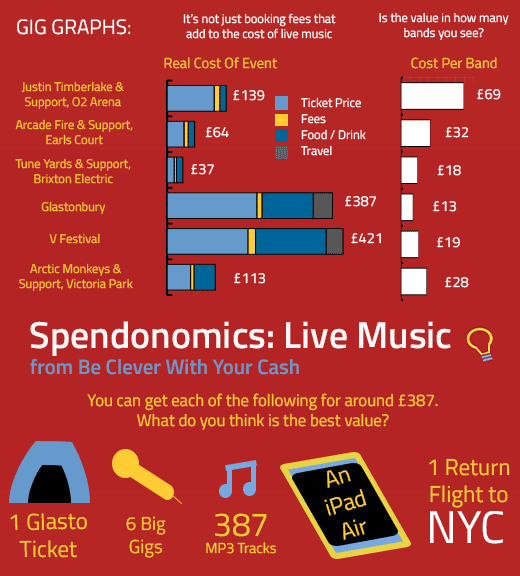
A while ago I compared the price of festivals and live music based on the cost per band. Glastonbury – pretty much the most expensive ticket to buy – has a full schedule for three days and has so many stages that you’ll see far more acts than heading to something like V Festival or a one-dayer in London. On that basis, even though the weekend festivals cost more, they’re usually much better value – as long as you can afford it in the first place.
How do you get value from live music

I like the cost per band method (I don’t expect you to actually work it out, just get a gist), though for some people what bands they see isn’t as important as who they’re with – I’ve got friends who miss half the day as they’re still recovering from the night before!

So you’ve got to think about what you expect to get from a weekend – and what else you would do with the money. When I produced the infographic above in 2014, for the all-in cost of a Glasto experience you could buy an iPad or return flights to New York!

Can you afford the extra costs?

I’d hoped to head to a festival in Portgual this summer. The ticket was a bargain £100 for three days of Radiohead, Arcade Fire and others, but when flights and accommodation were added in, it no longer made sense, and regrettably, I decided to give it a miss. But you don’t have to go abroad to add extra costs.

My cost-per-band infographic took into account some of the additional costs such as travel, food and fees. These will quickly add up.

Not all festivals are created equal here. Some, such as Glastonbury, will let you bring food and drink onto the festival site, saving you a decent amount – if you can carry enough. Others won’t let you bring anything through the gate, forcing you to pay at least £5 for a pint of Carling.

Fees are one of my bug-bears, especially being charged postage for an e-ticket you print at home! Often they are unavoidable so do check the total cost and shop around different websites as they all charge different amounts.

Can you pay less for a ticket?

One option is to wait for a special offer – and these aren’t as rare as you might think.

For the last two year there have been discounts for British Summer Time on sites like Groupon. There’s also been a bargain £2.50 plus charitable donation flash sale each year in the days before the event.

With this in mind, I’m going to hold off buying my ticket.

Whether you do this depends on how popular the festival is and whether you’re willing to risk missing out.

If you want to go to Glastonbury you needed to get tickets as soon as they were available and pay the full whack – if you’re lucky enough to get through.

But over the last few years most of the other festivals haven’t been selling out. It’s always a risk, but I choose to wait and see before committing my cash.

I’ve a festival deals page I’ll update when I find cut price tickets. Last year there were savings to be found on Bestival, V Festival, BST and many one day festivals. This year I’ve already seen £20 off Field Day and I’m sure we’ll see more as festival season approaches.

What about resale sites?

I’d stay well clear of sites like Viagogo and Stubhub. You’ll pay over the odds and there’s no guarantee you’ll buy a legitimate ticket. Though you’ll usually get a refund if it turns out your ticket isn’t valid, that won’t cover the cost of getting there and the disappointment of not getting in with all your friends.

Other ways to save

Some festivals – such as Bestival – offer discounts for students (don’t forget, it’s easy for anyone to legitimately get an NUS card).

If you’ve got the time you can often volunteer and get free ticket in exchange for a few shifts in the car park or behind the bar.

You can also keep an eye out for smaller festivals which might not have the big name acts but will cost a lot less – or even be free!

>> For more tips read my 8 ways to save at a festival article

So, rip-off or great value?

My last Glasto experience had some fantastic moments, but also one day where I didn’t really like any of the bands, reducing the value I got from my hefty ticket, travel and food costs.

I love live music, and for me there’s nothing quite like a good festival. But with prices higher than ever before so I’ll now only go to festivals which have a cracking line up.

So my advice is to try my cost per band method, or work out your own system, and see if you think the festival you fancy is going to be better than a flight to New York or an iPad.

Be Clever With Your Cash turns three!

Wow, it’s three years since I told the world (ok, my Facebook friends) about Be Clever With Your Cash. Three years since I went from mid-career “what do I want to do?” crisis to a proper personal finance journalist.

I don’t often write blogs like this, but since a huge amount has changed, even in the last 12 months, I thought it would be good to reflect on some of that – and what the next year holds. Plus, at the bottom of the page I’m keen to get your thoughts on the content I produce for you.

The blog

In the last year, I’ve written close to 100 articles and updated dozens and dozens of deals. Which means there’s a good chance you might have missed one or two. So here are some highlights from the last year:

My favourite posts from the last year

I’m always amazed that traffic to the blog keeps growing every month. There are now around 75,000 views a month and in total 1.5 million since I started. If this carries on and grows a little there should be one million views in the next 12 months. I think that’s mad. But thanks for reading!

My career

A year ago the blog was my hobby. Now it’s the main part of my working week.

In October last year, I cut my hours at my day job. I’m now working three days a week on the blog and my UK Money Blogger community.

I’m doing more freelance work too. I write regularly for Moneywise magazine and giffgaff money. And, I’m the new money columnist for Readers Digest!

I enjoyed my years working at the BBC and again at The Money Advice Service, but it’s not until now that it’s all clicked. Self-employment (even if just part-time) really suits me. I hadn’t ever considered it as an option, but I really wish I’d started earlier!

Going multi-media

This is the weirdest development. In all my years at the BBC behind the camera, I hated the idea of being on screen.

But in the last year I’ve been a money expert for BBC Right on the Money team last Summer, vox-popped punters in Manchester for Rip Off Britain and even appeared on BBC Breakfast on Black Friday. I’ve also become a semi-regular on the Share Radio morning show, reviewing the papers and fighting for consumer rights.

The more I do it, the less nervous I am and the more I enjoy it. In fact, I get a real buzz out of it.

So as a result, I’ve set up my own Cash Chats podcast every week and I’m increasing the video content for the blog too (you can subscribe to my YouTube channel here). I enjoy producing this extra content for you, so I hope you enjoy listening to and watching it as much.

What do you think?

The blog is still just me, deciding on a whim what to write. Obviously, some stuff is more popular than others, and I can’t write about everything – so I want to know what you want me to write about. If you’ve 5 minutes, I’d really appreciate you filling in the survey below.